
The Coming Demographic Reckoning: Should India Rethink Retirement in the Age of Longevity?
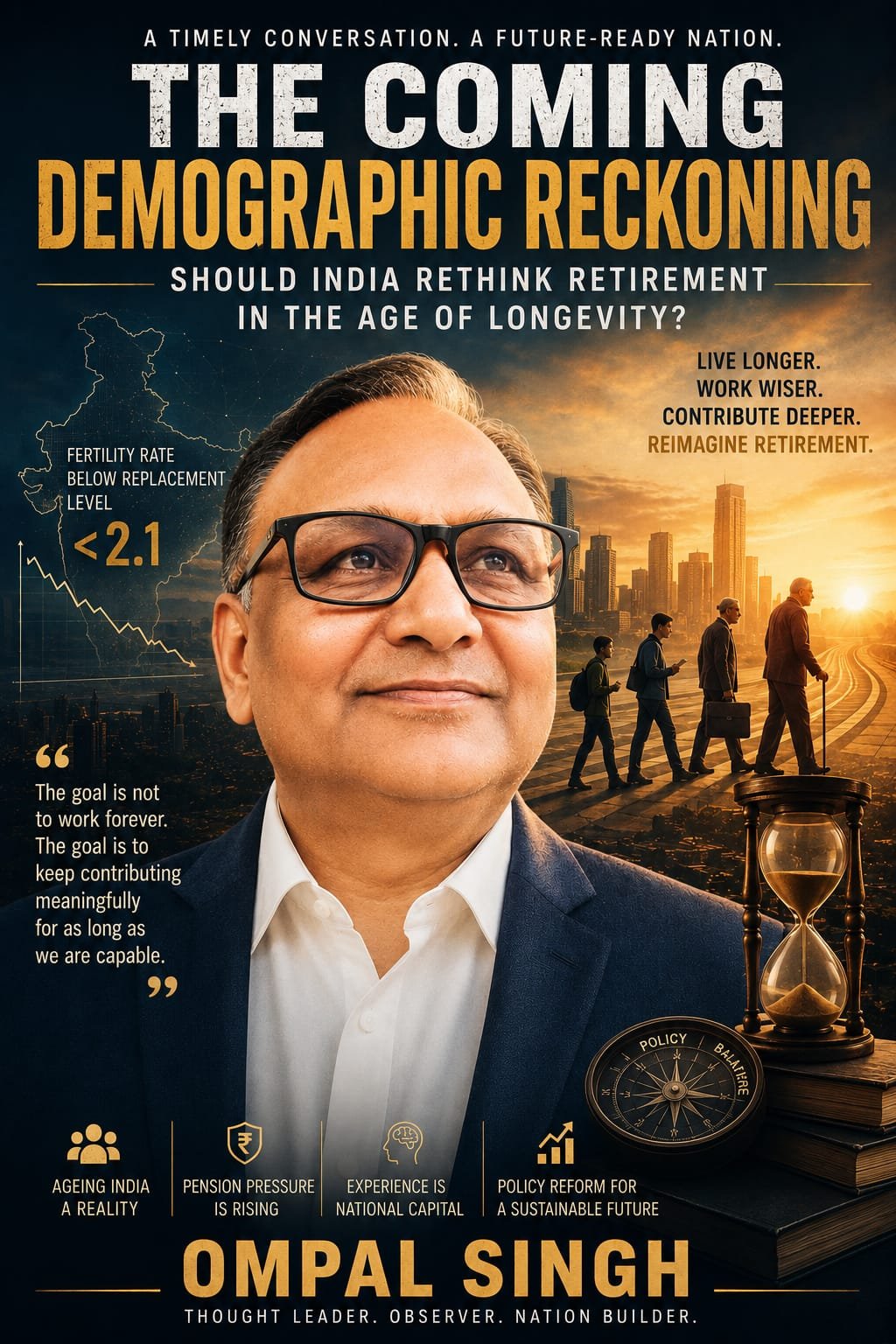

By Ompal Singh
For decades, India has celebrated its demographic dividend. A young population, a growing workforce, and a seemingly endless reservoir of human capital have been viewed as the engines of the nation’s economic ascent.
However, a profound demographic transition is quietly unfolding.
India’s fertility rate has now fallen below the replacement threshold of 2.1 births per woman—a milestone that may appear insignificant today but carries transformative implications for the nation’s future. Simultaneously, advances in healthcare, nutrition, and living standards are extending life expectancy, creating a society that is not only larger but significantly older.
This raises an important policy question:
If people are living longer and fewer children are being born, should retirement itself be reimagined?
The End of the Infinite Workforce Assumption
Throughout modern history, economic systems have largely operated on a simple demographic principle: a broad base of young workers supports a relatively smaller retired population.
That assumption is beginning to erode.
As fertility rates decline, the inflow of younger workers gradually shrinks. Meanwhile, the number of retirees continues to expand due to increased longevity. The result is a growing dependency burden, where fewer workers must sustain more pensioners through taxation, social security systems, healthcare expenditures, and public services.
This phenomenon is already challenging many advanced economies. Countries across Europe, East Asia, and North America are grappling with the fiscal consequences of ageing populations.
India still possesses a demographic advantage, but demographic trends are relentless. What appears distant today often becomes unavoidable tomorrow.
Longevity Demands a New Social Contract
Retirement ages around the world were largely designed during an era when life expectancy was considerably lower.
When retirement policies were first conceived, many individuals spent only a limited number of years in retirement. Today, millions can expect to live two or even three decades beyond the traditional retirement threshold.
The mathematics of ageing has fundamentally changed.
If a citizen remains healthy, productive, intellectually capable, and economically active well into their sixties and seventies, does it make sense for society to continue applying retirement models developed for a different century?
The question is not whether people should work forever.
The question is whether modern longevity requires a modern definition of work, retirement, and ageing.
A Progressive Retirement Framework
One possible solution is a gradual and predictable increase in retirement age.
Rather than imposing abrupt reforms, governments could consider raising the retirement age by two years every three years, allowing institutions, employers, and citizens sufficient time to adapt.
Such a framework would provide several strategic advantages:
Preserving Workforce Strength
A shrinking younger population can be partially offset by retaining experienced professionals for longer periods. This would help sustain productivity and institutional knowledge.
Strengthening Fiscal Sustainability
Longer working lives generate additional tax revenues while reducing immediate pressure on pension systems and social welfare budgets.
Harnessing Human Capital
Senior professionals possess decades of accumulated expertise, judgment, and leadership capacity. Premature retirement often results in the loss of invaluable intellectual capital.
Supporting Economic Growth
As populations age, maintaining labor-force participation becomes increasingly critical to sustaining GDP growth and national competitiveness.
Rethinking the Definition of “Senior Citizen”
Perhaps an equally important conversation concerns the age at which society defines someone as a senior citizen.
The label itself carries implications for employment, benefits, taxation, healthcare, and social perception.
If average life expectancy continues to rise, should the threshold for senior citizenship remain fixed?
A person aged 60 today often bears little resemblance—in health, mobility, education, and productivity—to a 60-year-old several generations ago.
Chronological age and functional age are no longer synonymous.
Public policy must evolve to reflect that reality.
The Counterargument: Protecting Opportunities for Youth
Critics rightly argue that extending working lives could restrict opportunities for younger generations.
This concern deserves serious consideration.
However, economic growth is not a fixed pie. Expanding economies create new sectors, industries, technologies, and employment opportunities. The objective should not be to choose between youth and experience but to create systems where both can thrive simultaneously.
A healthy economy requires intergenerational collaboration, not intergenerational competition.
The challenge is therefore not merely extending careers but ensuring continuous job creation, skills development, entrepreneurship, and innovation.
The Age of Active Ageing
The twenty-first century is witnessing the emergence of a new social reality: active ageing.
Many individuals in their sixties and seventies are healthier, more educated, and more economically capable than any previous generation. They are not passive dependents but active contributors to society.
The future may therefore require a shift from the traditional life model of:
Education → Employment → Retirement
toward a more dynamic model of:
Education → Employment → Reinvention → Flexible Work → Active Longevity
Such a transformation would not merely benefit governments and economies; it would empower individuals to remain engaged, purposeful, and productive for longer periods.
Conclusion
India stands at the threshold of a demographic inflection point.
The decline in fertility rates and the rise in life expectancy are not temporary trends; they are structural forces that will shape the nation for decades to come.
The debate is therefore not about retirement alone. It is about how societies adapt to longevity, how economies sustain prosperity amid demographic change, and how nations redefine the relationship between age and productivity.
The greatest challenge of the twenty-first century may not be population growth.
It may be population maturity.
The countries that recognize this shift early—and design policies accordingly—will possess a decisive advantage in the decades ahead.
The future belongs not merely to young nations, but to nations that learn how to harness the full potential of every generation.
— Ompal Singh